
Madison Parish Arrest Records and Court Charges
Madison Parish arrest records begin on the law-enforcement side. The Madison Parish Sheriff's Office investigates felony and misdemeanor crimes, operates the parish jail, transports prisoners, and forwards investigations to the Sixth Judicial District Attorney's Office for prosecution. That makes the sheriff or jail source relevant for recent custody, booking, bond, or arrest confirmation, but it does not make the sheriff the keeper of every later court filing.
The court charge record begins when the prosecutor files formal charges in the Sixth Judicial District Court. Those filings are handled through the Madison Parish Clerk of Court, Hon. Marion Hopkins, at 100 North Cedar Street, P.O. Box 1710, Tallulah, LA 71282. The Clerk's office can be reached at 318-574-0655 or mhopkins@madisonparishclerk.com during Monday through Friday public hours of 8:00 a.m. to 4:30 p.m. For court charges after arrest, the Clerk record is usually the better source for filed charge language, docket entries, plea entries, sentencing entries, and case disposition.
Sheriff Records Before Court Filing
The sheriff's official duties page is the local source that ties Madison Parish arrests to court responsibilities: Madison Parish Sheriff's Office duties.
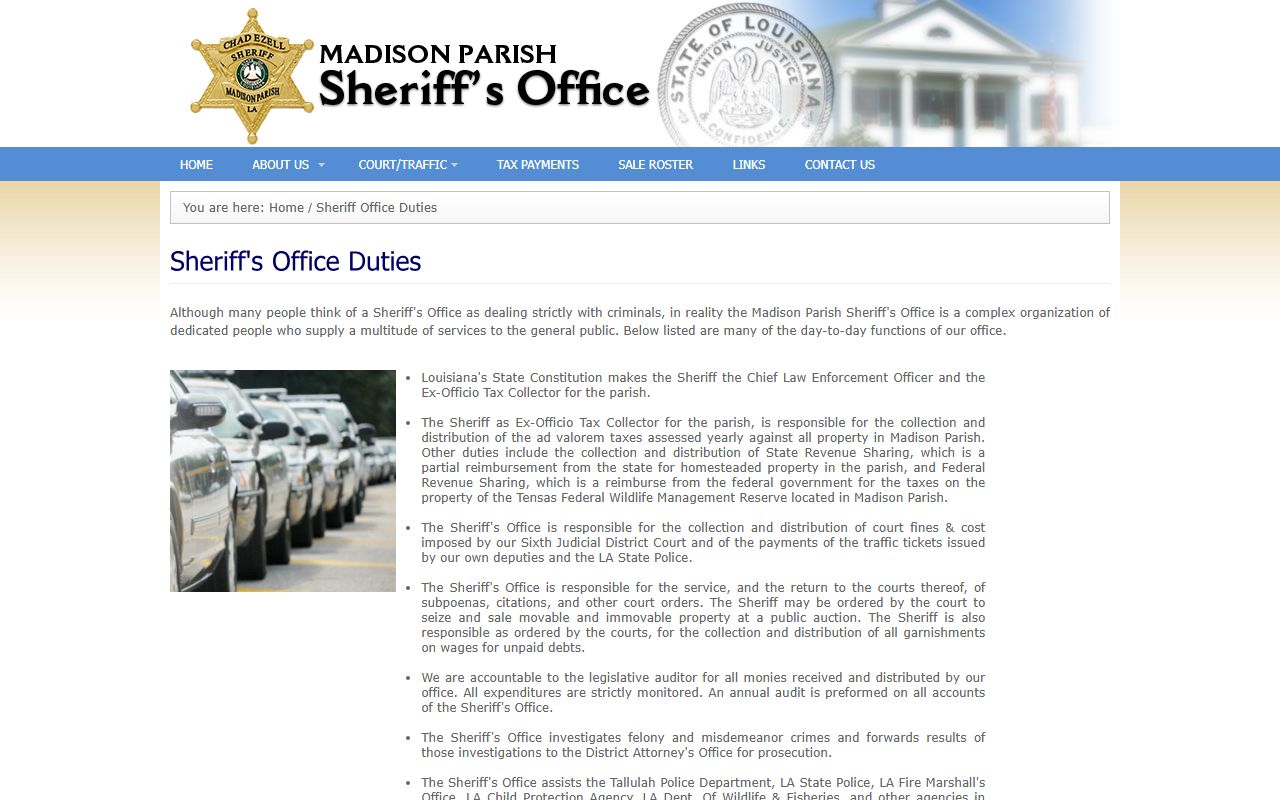
The same office that investigates crimes and runs the jail also serves court orders, supplies bailiffs for Sixth Judicial District Court sessions in Madison Parish, and collects court fines and costs. That overlap explains why an arrest search often starts with the sheriff but must move to the Clerk once charges are filed in court.
How to Find Madison Parish Arrest Records and Charges
For a recent arrest, first separate the custody question from the court-charge question. The Madison Parish Jail houses about 36 pretrial inmates and is operated by the Sheriff's Office at the courthouse building, Room 3, 100 North Cedar Street, Tallulah. The official jail roster path is the Madison LA VINE endpoint at madison.lavns.org, with statewide notification access through VINELink Louisiana. If the roster does not load or the arrest is too recent to display, call the Sheriff's Office at 318-574-1831.
- Check custody or recent booking through the Madison LA VINE roster endpoint, VINELink Louisiana, or the Sheriff's Office phone line.
- For filed charges, search or request the court case through the Madison Parish Clerk of Court. The Clerk links online records through the Madison Parish Cott eSearch login at cotthosting.com/LAMadison.
- If online access is unavailable, account-gated, not indexed, or too old, contact the Clerk in person, by mail, phone, or email with the defendant name, approximate arrest date, case number if known, and charge information.
- Read each charge separately. One arrest can produce several counts, and each count may have a different status, bond condition, plea, sentence, dismissal, or expungement history.
The Clerk's online options may also route through eClerksLA or ClerkConnect, both of which are linked from the Clerk's official records environment. Those systems are not a guaranteed free, complete public search for every criminal charge; they are access channels that may depend on account status, user role, record availability, and case type.
Complaint, Information, and Indictment
After an arrest, the law-enforcement allegation does not automatically become the final court charge. The Sixth Judicial District Attorney's Office receives investigations from the Sheriff's Office, screens the facts, and decides whether to file a bill of information, seek an indictment, reduce a charge, decline a count, or proceed in another way allowed by Louisiana criminal procedure. In practice, that means an arrest record may use one label while the court file later uses a more specific, amended, or different charge.
| Document | Who Uses It | Common Role | What to Check |
|---|---|---|---|
| Complaint | Law enforcement or prosecutor | Starts or supports an accusation after arrest | Agency, date, factual basis, defendant name, and any warrant or bond reference. |
| Bill of information | District Attorney | Prosecutor-filed formal charge in many Louisiana criminal cases | Filed charge, statute, count number, docket number, amendments, and arraignment entry. |
| Indictment | Grand jury | Formal accusation generally used for serious felony matters | Indicted count, filing date, court division, bond order, plea, and disposition. |
District Attorney Screening and Defense Access
The district attorney resource for Madison Parish is the Sixth Judicial District Attorney's Office, serving East Carroll, Madison, and Tensas Parishes. Because local DA leadership information was time-sensitive in the research notes, stable record copy should refer to the office rather than relying on a named prosecutor unless an official current source has been verified. The DA is the office that receives sheriff investigations, files bills of information or seeks indictments, handles pleas and trials, and may make sentencing or diversion recommendations.
The public defender side is different. The Louisiana Public Defender Board maintains district-office routing through lapdonline.org and its district-office locator. Public defender files are not public court-search files; they are attorney-client representation records. A person trying to understand charges should use the Clerk's court record for public docket and filing information, and use counsel for advice about strategy, eligibility, surrender, bond, diversion, or expungement.
Charge Status and What It Means
A Madison Parish criminal case can move through several charge statuses before it is over. The first booking allegation may be screened by the DA, the filed charge may be amended, one count may be dismissed while another proceeds, or the case may end in a plea, trial verdict, probation order, sentence, or dismissal. The safest reading is count by count, not just case by case.
| Status | What It Means | Where It May Appear |
|---|---|---|
| Pending | The charge has been filed or is awaiting further court action, and no final disposition has been entered for that count. | Docket, minute entry, arraignment, bond, or hearing setting. |
| Amended or reduced | The prosecutor or court record reflects a changed charge, level, count, or statutory basis from the earlier allegation. | Bill of information amendment, plea entry, or minute entry. |
| Dismissed | The court record shows the count or case was dismissed, with or without prejudice depending on the order. | Disposition entry, judgment, or prosecutor filing. |
| Nolle prosequi | The prosecutor declined to continue a charge at that stage. It is not the same as a finding of innocence. | Minute entry or written dismissal filing. |
| Convicted or sentenced | A guilty plea, verdict, or judgment of guilt has been entered, followed by sentencing or probation terms. | Plea form, minute entry, sentencing order, probation document, or judgment. |
Charges vs. Convictions
Being arrested or charged in Madison Parish is not the same as being convicted. An arrest record reflects custody or accusation by law enforcement. A charge reflects the formal accusation being pursued in court. A conviction requires a guilty plea, verdict, or judgment of guilt. This distinction is critical for background checks, housing decisions, employment questions, licensing, and personal record review.
| Comparison | Charge | Conviction |
|---|---|---|
| Stage | Formal accusation filed or pursued after arrest. | Final guilt outcome by plea, verdict, or judgment. |
| Proof level | Based on accusation and prosecution decision. | Requires proof or admitted guilt under criminal procedure. |
| Record source | Clerk docket, charging document, minute entries, and sometimes jail context. | Disposition, plea, judgment, sentencing entry, probation order, or court minutes. |
| Practical reading | Do not treat a pending charge as a final outcome. | Read sentence, probation, restitution, and expungement status separately. |
Sealed and Expunged Charge Records
Louisiana criminal-record access is limited by sealing, expungement, juvenile confidentiality, court orders, redaction rules, and specific statutes. La. C.Cr.P. art. 971 defines expungement terms, and La. C.Cr.P. art. 972 addresses general expungement availability and limits. Expungement in Louisiana generally restricts public access to qualifying arrest or prosecution records; it does not mean every agency record is physically destroyed or unavailable for every government purpose.
| Comparison | Sealed | Expunged |
|---|---|---|
| Public visibility | Hidden or restricted by court order or confidentiality law. | Restricted from ordinary public access if the court grants the expungement. |
| Law-enforcement access | May remain available to authorized agencies depending on the order and law. | May remain available for law-enforcement, licensing, or statutory exceptions. |
| Madison Parish path | Request access through the court only if legally authorized. | Identify arrest, charge, final disposition, eligibility basis, and file through the proper court process. |
Registry Records Are Separate
Some criminal outcomes can also trigger state registry obligations. The related official source is the Louisiana State Police sex offender and child predator registry information.
A registry listing is not the same thing as a Madison Parish booking record or a Clerk case file. Use the registry for registry-specific information, use the Clerk for court filings and dispositions, and use the sheriff or LA VINE for current local custody questions.
State Criminal History and Federal Charges
A local court-charge lookup is not a complete statewide or national criminal-history check. Louisiana Public Records Law, including La. R.S. 44:1 and La. R.S. 44:31, supports access to non-exempt public records, but it does not override sealed court files, juvenile restrictions, expungement limits, or redaction requirements. For formal Louisiana criminal-history or background-check purposes, use the current state process identified by the responsible state agency rather than assuming the Madison Parish court file is the whole record.
Federal criminal prosecutions are also separate. Madison Parish local charges are handled through the parish and Sixth Judicial District Court path, while federal cases are filed in the U.S. District Court for the Western District of Louisiana and searched through federal systems such as PACER. The Western District of Louisiana and the U.S. Attorney's Office for the Western District of Louisiana are useful sources when the charge is federal rather than parish-level.
The federal court source for Madison Parish federal cases is the Western District of Louisiana.
Federal charge information should not be requested from the Madison Parish Clerk unless a related local case also exists. Use PACER or the federal court's own instructions for federal dockets.
The federal prosecutor source is the U.S. Attorney's Office for the Western District of Louisiana.
The U.S. Attorney handles federal prosecutions, not ordinary Madison Parish district-court charges. That distinction helps prevent mixing a parish arrest record with a federal indictment or federal custody matter.
Restricted Charge Records in Madison Parish
Not every charge-related record is public. Juvenile matters are generally not public in the same way adult criminal files are. Adoption records, protected-person addresses, mental-health material, medical details, Social Security numbers, financial account numbers, victim-sensitive information, and sealed or expunged material may be withheld or redacted. Protective-order information may appear in some court and law-enforcement contexts, but sensitive details can be restricted.
For certified copies, charge dispositions, and court-file review, ask the Madison Parish Clerk before mailing payment because the research did not locate a verified local fee schedule for criminal certified copies. For jail, bond, and recent arrest questions, call the Sheriff's Office. For legal advice, eligibility to expunge, or how to respond to a pending charge, speak with an attorney or the appropriate public defender office rather than relying on a public-record search alone.
Important: Public charge records are not consumer reports and should not be used for FCRA-regulated decisions without a compliant source.